
Malaysian Tea
The Malaysian way…

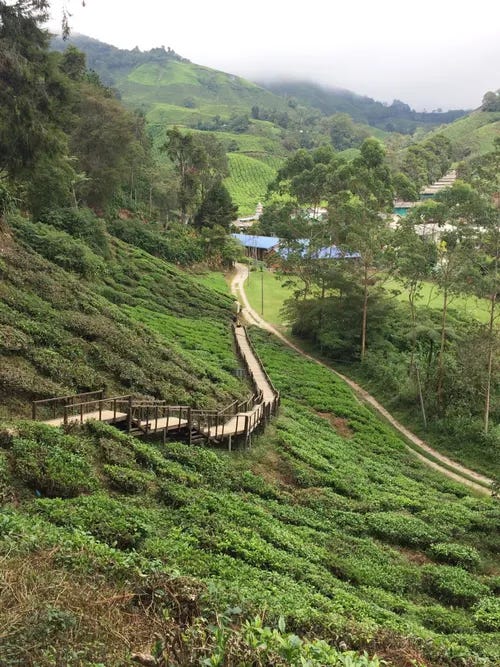
It’s a Monday morning and I’m logging on to my computer… Microsoft of course has to flash this epic photo on the screen of a beautiful mountainous area, with the slopes terraced in tea plants… and then they ask me if I like it… really?…downright cruel… it’s as if somehow they knew I relish the summits and the tea…
Well, anyway I click yes, assuming it’s somewhere in China… but no, it’s in Malaysia…? Huh…? Back to work… read my emails, check repair tickets and pull out the wrenches… as I’m working, the podcast becomes a garbled noise in the background as I can’t get my mind off “Malaysian tea”…
The wrenches turn on auto pilot, as time passes quickly…. my thoughts interrupted finally by annoying background music playing as the podcast host or producer run through five minutes of sponsor ads… I get up off the floor and check the time… yes, time for a break… I grab the phone, and of course I feel the need to research this….
A Little History
Tea first came to Malaysia in 1929 by a Scottish businessman, JA Russell. He established the commercial estate called BOH Plantations in the Cameron Highlands, which today is the largest in Malaysia. Today, there are three major tea plantations, producing a total of 3.6 to 4 million kilos of tea annually, with black tea being their primary product.
Located in the Cameron Highlands, they are the largest of the three, producing about 4 million kg annually, which accounts for roughly 70% of national output.
BOH operates two tea gardens, their own and Sungei Palas Tea Garden that they purchased in the 1950’s.
In 2007 they built a visitor center and cafe, they dubbed JA’s Balcony after their founder. It has a 20 foot overhanging balcony/viewing deck. In 2019, the latest addition was an expansion of the visitor center to include a viewing deck that seats 200 people with the usual gorgeous panoramic views. Sounds like an amazing tea experience.

The unique terroir and specific sensory profile makes it a black tea perhaps that will be different than any other you may have experienced… The landscapes and unforgettable panoramic views will leave you holding your breath.
Perhaps that’s why I couldn’t forget about it after seeing the pic on my monitor …
Bharat is the second largest tea producer in Cameron Highlands, Its primary estate is Tanah Rata, and features two tea houses situated slightly apart from each other along the main road.
At the first tea house you can walk down a valley to a small park and waterfall and the second tea house is in a larger complex with a larger parking area. Both tea houses have product shops and cafe’s with decks that overlook impressive views of the valley.
***Although the second largest tea producer, between Bharat and Sabah Tea, together they account for roughly the other 30% of national output for Malaysia.***
Sabah Tea beginning in 1973 is the largest tea producer in Borneo and cultivated 2,272 feet above sea level at the foothills of Mount Kinabalu, Malaysia. One impressive fact of Sabah Tea is that it is the only organic tea farm in Borneo. It produces 100% pesticide-free black tea using pure Camellia Sinensis leaves.
Although at a lower altitude, the serenity of the landscape is just as inviting and stunning. Sabah promotes themselves as a tea resort, with two bungalows, longhouses and cottages so you can stay right near the fields and experience their own tea ceremony to complete the experience.
Entry to the tea farm is free and guided factory tours are available for approximately 10-15 RM, including a cafe serving tea infused dishes like tea smoked chicken, tea pancakes… sounds interesting…
What Makes it Different From Other Black Tea
While I must admit, until I saw the photo of the amazing tea fields I didn’t realize tea was grown in Malaysia… 70% of the time I drink Puerh tea offerings, and the other 30% of the time I drink oolongs and Japanese greens, but of course I intend on trying some very soon. That said, I have sampled a very good creamy Assam as well as other black teas, and wondered how the Malaysian Black would differ in taste…
Researching it, it seems the uniqueness is influenced by the,
Terroir: Not only the high altitude (1500 meters (5000ft), but the cool mountain climate near the equator, abundant rainfall and untainted, acidic nutrient rich soils create a lively flavor profile, bright astringency and a distinct smooth and caramel finish.
Processing: Most black tea’s like Assam are meant to be steeped and sipped strait, as you squint through the steam and solve lifes mysteries… Malaysian black tea is typically processed and roasted specifically to pair with condensed milk and/or evaporated creamer.
Preparation: They call it Teh Tarik. The tea is brewed very strong, then blending in evaporated creamer and/or condensed milk. Then there is the unique process of “pulling” it back and forth between two containers. This cools the drink, aerates it, and creates a signature frothy foam on top…
Sabah Tea in Borneo being at a lower altitude creates a different flavor profile with their tea. The microclimate and lower altitude creates a more smooth, light and mildly floral cup that is less bitter. I have not yet tried it yet, but it sounds more in line with a Japanese Green, and I definitely want to give it a go…
Conclusion
As indicated in the beginning I didn’t even realize that Malaysia had tea fields. In the shadow of large tea producers like China, India and Kenya it is easy to see why. But I like to at least try something before I dismiss it as a runner up.
I don’t think anything will take the place of Puerh at the top of my “tea mountain”… but I’m looking forward to see how it compares with my other 30%…
As far as Malaysia’s method “Teh Tarik” it has quite the cult following from what I read. Although I’m not a big fan of cool tea, condensed milk or in general sugaring up my tea, I’d like to try it… I love experiencing different cultures and their different teas and food…
So after I try some, I’ll post about the experience and provide my own opinion…
Until next time my friends,
Raj