
Beyond the Blackberry….
It’s all about that leaf…

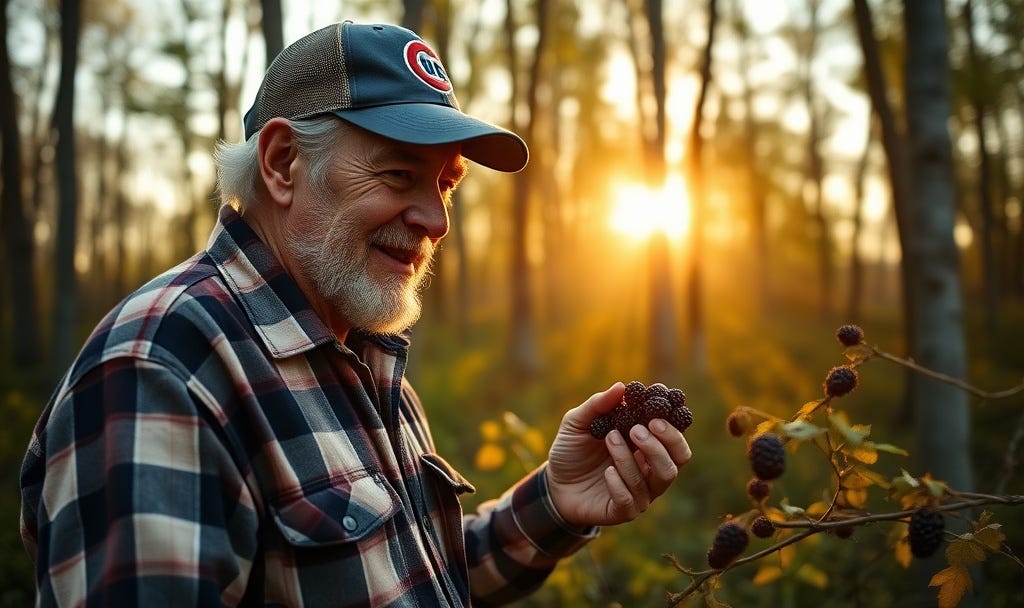
Hunting in our timber as a youth, I always enjoyed plucking a few blackberries as I traversed the timber. They were sweet and had a slight astringency which I prefer over the large commercially produced blackberries today, that are the size of small plums and injected with enough sugar to put a can of Mountain Dew to shame… The wild blackberries in my opinion are much more healthy.
Slowly, I’m transforming my backyard into a native plant and food garden… A couple of years ago I spotted a humble little blackberry bush, while helping my father on the farm… nowadays dad just automatically puts the spade in the gator, as he knows there is something I’ll dig up… and, dig it up I did, rescuing it from the Midwest Prairie, from which it came… the berries are just starting to form….

About the Wild Blackberry
The Wild Blackberry( Rubus Fruticosus) produces a sweet, juicy berry. The flowers bloom in clusters from April to Mid May in my part of the Midwest. The petals on most here are white, with streaks of light pink.
The berries begin to form around mid-may, and ripen from June through August. They change from a light green, to red, and then finish to a black or dark purplish color.
The leaves are usually 3-5 per stem, oval in shape with sharp distinctly toothed leaves. The top of the leaf is a bold green, and almost whitish to pale green on the underside.
The stems, are referred to “Canes” and have aggressive, sharp thorns. Believe me, there is a reason these bushes are also referred to as brambles. If you have ever encountered them in the wild, you will know what I mean. They are aggressive growers and can become invasive if you don’t control them. The roots grow horizontally, expediting their aggressive growth habit.
In order to benefit from this one, I have to prune it hard and often to harness its desire to spread.
How to Identify and Forage these delectable Berries
As far as I know the Wild blackberry has no toxic look alike, and if using the description above you should be able to identify them fairly easy. There is one cool difference between the Wild Raspberry and the blackberry. If you pick what you think is a raspberry and it makes you slightly pucker, you will know you have a blackberry that isn’t quite ripe yet. The other part is that when raspberries are plucked from the vine, it is hollow inside the berry. However when you pluck a ripe blackberry from the vine, the whitish core remains inside the berry.
Ways to Use
The berries are delicious, however stopping at just the berries you’re missing the majority of the benefits from this nutritional powerhouse.
In addition to the berries, the leaves, roots, and bark have many uses in traditional herbal medicine.
Cooking
You can make the berries into into jams, jellies, syrups or make a compote to put over your desserts and ice cream. My grandmother used to bake them in her muffins, bread pudding and cobbler… the list goes on…
Teas and Tinctures
Another way to use them are in teas and to make tinctures. This is my favorite way to use the leaves. A favorite summertime cold brew I enjoy is fresh blackberry leaf, dried cut ginger, fresh mint leaves and 2 to 3 cloves.
For a 12oz glass bottle, I add 10-15 blackberry leaves, 1 tsp of dried cut ginger root, 5-6 mint leaves and 2-3 cloves. To this add filtered water, cap it, put in the fridge overnight and strain out the herbs into another glass bottle. I take this to work and sip on it throughout the day.
In the spring, winter and fall I make the same tea hot using dried leaves, it is just as good. And anytime it’s been a long day, I’ll still make a hot brew, it’s relaxing.
Benefits for Health
This is where it gets interesting in my opinion. As mentioned every part of the bush has a medicinal use. Loaded with Vitamins C,K, Manganese and fiber, both the fruit and leaves are very high in antioxidants that help manage inflammation and promote overall wellness.
Leaves
Tannins- the leaves are very astringent helping to relieve diarrhea and dysentery, and all around digestive discomfort and issues.
Anti microbial and inflammatory properties- They have been used for a long time as a mouthwash to treat gum disease, ulcers, and sore throats and also as a poultice for wound healing.
Antioxidants- The antioxidants found in the leaves, may assist in supporting cardiovascular health, protection for your cells and blood sugar regulation.
Berries
Anthocyanins and flavonoids- Rich in these, the berries destroy free radicals, thus potentially cutting the risk of heart disease, cancer, and age related degeneration.
Fiber- These delectable berries are high in fiber, approximately 8g per cup which aid in digestion.
Manganese, iron and Vitamins C, K- Manganese is important for bone metabolism, iron assists in dealing with anemia, vitamin C is essential for strengthening the immune system in allowing your body to fight off colds and infections. It is helpful in helping reduce cholesterol levels and blood pressure, helps in absorbing non-heme iron, it’s important for collagen helping your skin stay elastic, helps promote wound healing. Vitamin K helps the body to clot the blood, it supports bone density therefore reducing fracture risks, and assists in prevention calcification of the arteries. More recent research shows potential benefits with insulin sensitivity, blood sugar regulation, and cognitive function.
Roots
Tannins- the tannins in the root are the highest of all three parts of the plant listed here. It has been used for years traditionally to tone, and tighten the intestinal lining.
Styptic and hemostatic agents- it is helpful for treating hemorrhoids, internal, external bleeding.
Other- Like the other parts but with more potency it potentially has anti cancer, anti microbial, antioxidant, and anti diabetic properties. Additionally, it is used as a diuretic and tonic.
Wild blackberry… until I started reading and studying about plants, particularly ones native to my region, I had no idea of the plethora of nourishing and medicinal properties of many of them.
As a kid and younger adult, I just knew they tasted good and wanted to eat them. Now, as mentioned I pick and dry the leaves during the summer, and pick fresh ones for teas and concoctions for various reasons.
Hopefully you’ve gained some new knowledge of the humble blackberry, and can try a cup of tea produced from its leaves, the taste to me is a slightly sweet flavor alone, and even better the way I listed above.
Until next time my friends,
Raj